
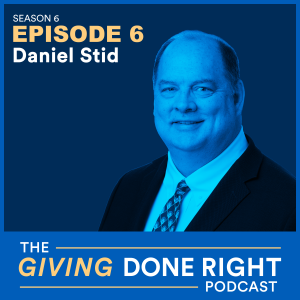
Is Philanthropy Fueling Polarization? With Daniel Stid
Daniel Stid, senior fellow at the American Enterprise Institute and author of the newsletter The Art of Association and host of a podcast by the same name, shares his provocative argument that large-scale philanthropic investment in national policy advocacy has, over time, deepened American polarization rather than healed it. Stid, who spent nearly a decade leading the Hewlett Foundation’s U.S. Democracy Program, explains why he believes funders on the left and right have increasingly bankrolled advocates clustered at ideological poles, making it harder for either political party to build governing majorities near the center where most Americans actually sit.
Phil pushes back, prompting a nuanced discussion of where philanthropy’s influence on democracy is concentrated versus diffuse. The two also debate whether philanthropically funded efforts to directly oppose the current administration are effective or counterproductive, with Stid arguing for what he calls “responsible pluralism”: funding advocacy aimed at building durable majorities through Congress, rather than unilateral executive action, regardless of which party wields that power. Phil challenges the underlying premise, arguing the current threat to democratic norms and civil society is categorically different from past administrations’ overreach.
The conversation closes on the nonprofit sector’s dependence on federal funding, a relationship Stid traces back to the Great Society era, and what he sees as an unavoidable reckoning now that the decades-long bipartisan consensus supporting that funding relationship has broken down. Both agree that philanthropy cannot fill the resulting gap alone, but see real opportunity for donors to give more, given how flat charitable giving has remained relative to the wealth concentrated among the richest Americans.
Guest Info:
Daniel Stid is a senior fellow at the American Enterprise Institute, where his work focuses on civil society, philanthropy, and democratic governance, and the author of the newsletter and podcast The Art of Association. He is also executive director of Lyceum Labs, a nonprofit focused on improving political leadership at the state and local level. From 2013 to 2022, he served as the founding director of the U.S. Democracy Program at the William and Flora Hewlett Foundation, leading $180 million in grantmaking aimed at strengthening American democratic institutions. Earlier in his career, he was a partner at the Bridgespan Group, a manager at Boston Consulting Group, a congressional fellow on the staff of the House Majority Leader, and an assistant professor of political science at Wabash College. He chairs the board of More in Common and is the author of “The President as Statesman: Woodrow Wilson and the Constitution.”
Credits:
Podcast Production: Cold Italian
Artwork: Jay Kustka
Resources:
The Art of Association
American Enterprise Institute
Hewlett Foundation, U.S. Democracy Program
Slow Philanthropy: Why giving by the ultra-wealthy often lags behind their ambitions—and what could help move money faster by Jeff Bradach
CEP’s State of Nonprofits report